
For a couple of years now, everyone has been talking about how much of a game-changer AI is. According to the messages out there, it’s really the only way we’re going to be able to cope with the constant stream of tasks flowing across our to-do list.
This morning I read yet another email about how we can use AI to shortcut something we were doing all on our own before. And since everyone seems to be saying it, it must be true. Right?
Uhh… no.
I think most of this advice is coming from a place of good intentions. But it’s easy advice. Not only does one specific method or strategy not work for everyone, but AI isn’t going to make you a better speaker on its own.
Also, how do you know that the “experts” are following their own advice? Or are they actually getting great results from using AI?
It seems to me that you can spend a lot of time feeling frustrated or like a failure because you aren’t able to keep up with all the movement in the world. When in reality you’re not the problem!
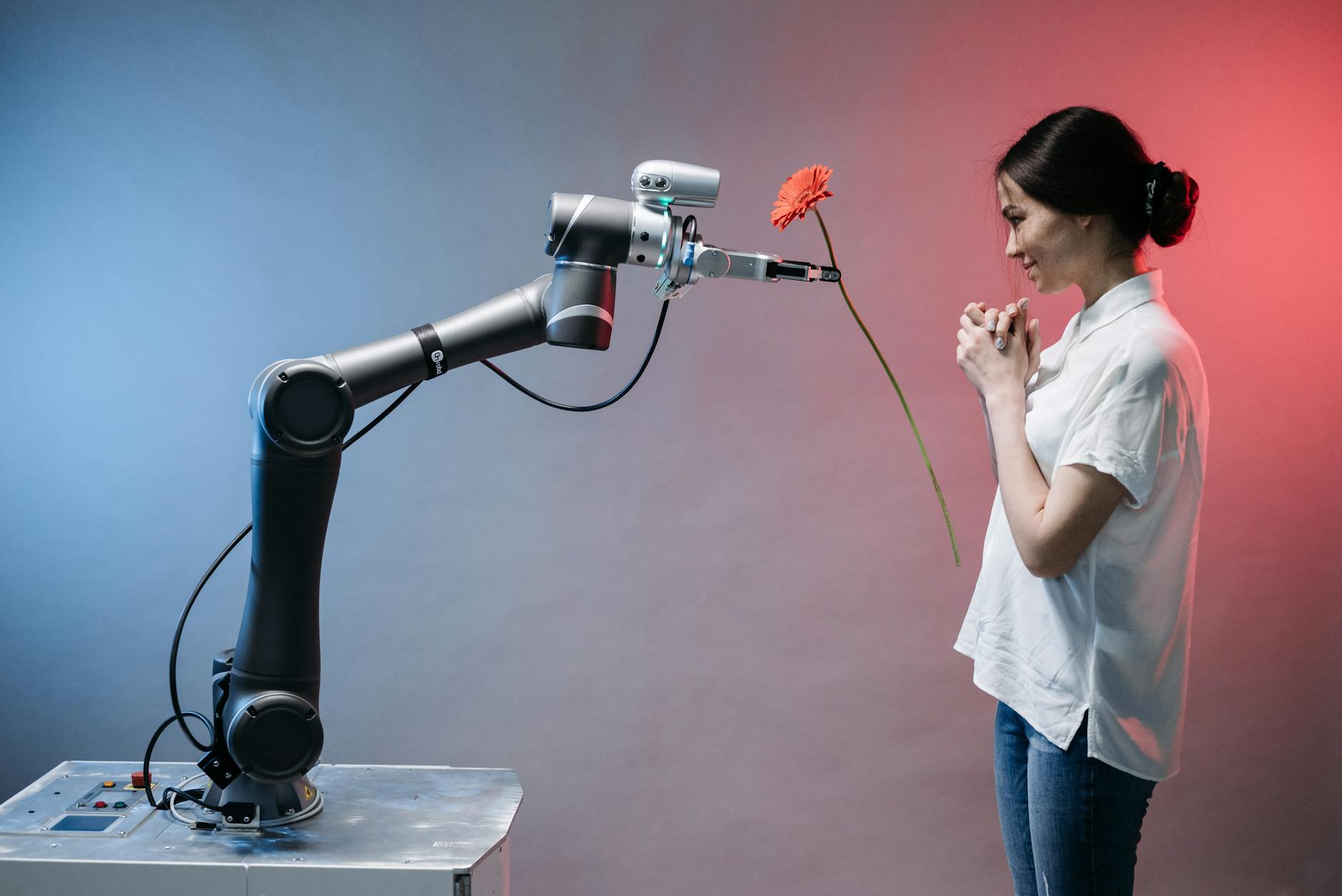
AI is an incredibly useful tool. It can provide a starting place for all kinds of work, but when it comes time to take your ideas, your work, and your results and share them with an audience, AI won’t be in the room helping you.
Today I’m going to break down the role of AI in really excellent and impactful public speaking – what’s the right time to bring your digital partner into the process, and when do you just need to go it alone.
I’m on board with AI. But as a public speaking coach and instructor, I clearly see its limitations and the boundaries around using it.
What AI is Good At – Know the Limits
Here’s the thing. In some situations AI tools like Chat GPT, Copilot, Claude are a secret weapon in your back pocket. I’ve sat and stared at a blank document and empty slides and wondered, how am I ever going to do this? Enter our partner, AI to get the ball rolling.
With a few details, AI tools built on large-language learning models can spit out a presentation outline, text for slides, an abstract, a bio, and more. You get an “answer” to your question wrapped in a bubbly and supportive human-like response.
New models can help translate written text (by you or the tool) into a presentation outline and the bullets you might want to include in your visual aids. They can generate custom images and graphics based on your description that easily pop into slides or a briefing deck.
These are powerful events.
It feels so amazing to see the computer “do it” for us. It is an incredible relief to have the page no longer blank and impatiently waiting.
Psychologically and practically, AI is hard not to love.
But, there are boundaries. We need some mental guardrails to avoid too heavily relying on this technological partner. Some things to consider:
- Most people aren’t great editors, especially when the content looks and feels “finished”. Although we’re told to use AI as a jumping-off point, few people know exactly how to effectively revise and edit AI-generated content to make it sound more authentic.
- When you write it, you know it. When you write something on your own, it’s a deep part of your memory and mental structure because it came from you. This makes it so much easier to remember in a presentation, to talk about in questions, and to build on in the future.
- AI content doesn’t technically belong to you. It isn’t your intellectual property and shouldn’t be shared with others as such. It’s becoming more and more common for content creators online to share when they’ve used AI to support the development of a piece of content.
- AI may seem like it knows the answer to your question. But it doesn’t actually “know” humans at all. It is merely able to reflect back what humans have created in mostly written content. It doesn’t know what your audience likes to do on the weekends, or how stressed they might be feeling during your presentation. You are 100% more likely than AI to know these things and how they might influence the way your audience interacts with you and your presentation.
Want proof?
- Forbes addressed AI’s presentation limitations in a recent article.
- AI itself recognizes its limitations
But, here’s the biggest guardrail of all.
No matter how sophisticated your AI brainstorming/development/writing support was, when you have to give a presentation it is just you, in the room in the seat, on the mic.
It is still up to you to outline your topic, validate why the audience should care, provide strong evidence, make the pitch, and answer the audience’s questions.
Regardless of the help you got along the way, it is all up to you as a speaker to deliver.
What can you do to make the actual presentation live up to its potential? Keep these things in mind.
Rising to the Challenge: How to Deliver in the Moment
When you’re up at the center of attention, delivery is going to bring your presentation to the finish line. And it’s here where you step out from under AI’s protective wing. To be ready for that moment, here’s the strategy for success you need.
Step #1: Practice the presentation out loud
No need to stand or overthink this. Just review your speaking notes and your presentation slides, if you have them, and rehearse the content of the speech. Two or three times is a minimum, or until you’re speaking mostly fluently, not perfectly, through the entire presentation.
For each run-through, make notes to yourself to help jog your memory where you’re having trouble. Edit and revise the words on your slides and those you chose to speak aloud.

You’re done with Step #1 when the words start rolling off your tongue and you start thinking, “Hey, this is coming together!”
Step #2: Get to your feet (or take your speaking position)
If you’ll be standing during your presentation, stand. If you’re presenting while sitting, for a virtual presentation, or in some type of conference/board room, sit.
But, practice like it’s the real thing.
How will you hold your notes? How will you look at the audience and the slides? How will you move your body? How will you move your hands?
I strongly encourage you to just go with the flow here! One of the biggest mistakes speakers make is to start overthinking what they’re doing with their body. Be yourself. There are no perfect gestures or steps to take or facial expressions to make.
You are this presentation so you should be you.
Again, rehearse here 2 – 3 times until you feel pretty confident you’re managing all these components pretty well.
Step #3: Record yourself
This is the real moment of truth. And even for me, this is absolutely the hardest part.
No matter how many presentations I give, I struggle to watch myself on video, at least for the first few seconds. I too, cringe.
And then I stop and I try to look at myself as an outsider would.
I tell myself, “You just look like a normal human.” And then I double down on my goal.

The entire reason I’m giving this presentation is to share something with the audience that is valuable and useful and important.
So, that’s what counts. Not how my hair is that day, or this weird thing I did there.
Big-picture thinking and tweaking fine details are all you need here.
Then, you’re ready. Knock ‘em dead.
Speaking Next Steps
So yeah, AI is a useful partner in the presentation preparation process. But it isn’t going to get you to your goal, your ideal outcome. You need to bring it home.
Once you’ve rehearsed and feel confident, the entire presentation will slide right into place for you. And by following this three-step process, you’ll be able to practice for any presentation in any situation.
If you find that you’re still doubting yourself or being overly harsh when you watch your video back, I’d encourage you to listen to my recent podcast episode about letting go of limiting beliefs.
All the rehearsing in the world won’t be enough to help you overcome negative thoughts that get you back and stifle your growth.
Also, check out my blog post on public speaking myths that just don’t seem to go away. These too keep us from reaching our full speaking potential.
Current wisdom can be little more than fads that don’t stand the test of time. Many won’t even get you where you want to go.
While AI seems to be here to stay, when it comes to presenting, you’ll need to finish strong and I absolutely know you can do it. All on your own.
If you want more support in the preparation process or overcoming your mindset about speaking, reach out. I’d love to work with you one-on-one to help you reach your goals.
Click here to contact me and let me know what you’re thinking!
Questions? Comments? Drop them below. I can’t wait to hear what you think!
To make sure you get the best information possible, this post was created without the help of AI.
Updated by Andrea Hamilton, March 3, 2025
Everyone has a voice. Use yours by Presenting Well.

Leave a comment